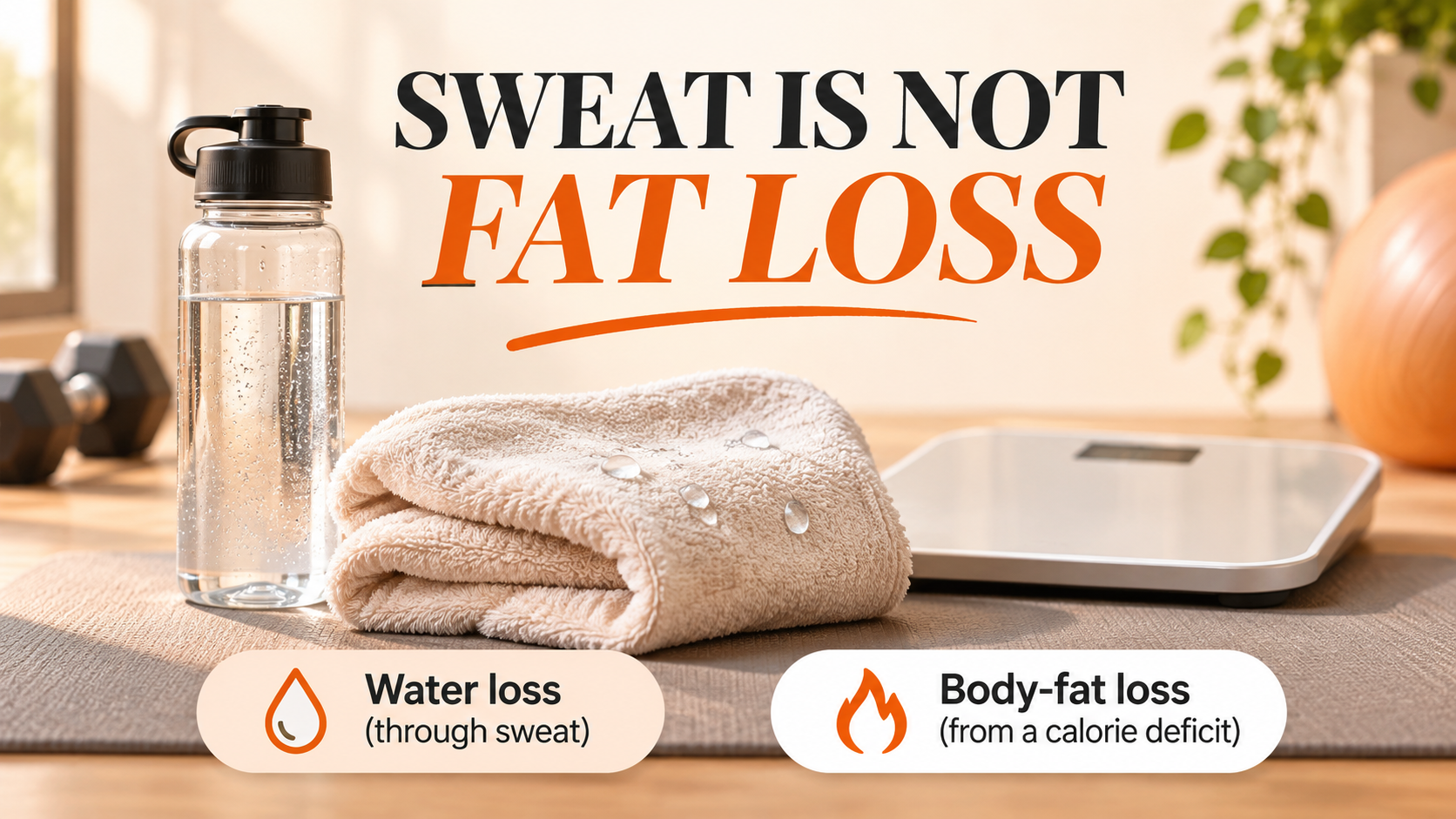
You finish a workout in Ahmedabad. Your T-shirt is soaked, your face is dripping, and the weighing scale shows half a kilogram less than it did before you started.
It feels like progress.
But here's a question worth asking: Did you lose body fat, or did you mostly lose water?
Sweating is a normal and important part of exercise. But the amount you sweat doesn't tell you how much fat you've burned.
Let's understand why.
Why Do We Sweat During Exercise?
Your muscles produce heat when you move. As your body temperature rises, your nervous system activates sweat glands to help cool you down.
When sweat evaporates from your skin, it carries heat away.
This is one of the ways your body regulates temperature.
How much you sweat depends on several factors:
- The temperature and humidity around you
- Your exercise intensity and duration
- Your clothing and ventilation
- Your individual sweating response
- How accustomed you are to exercising in the heat
This means two people doing the same workout can sweat very different amounts.
More sweat doesn't automatically mean more effort, more calories burned, or more fat lost.
Does Sweating Burn Fat?
Not directly.
Sweat is mainly water, along with electrolytes such as sodium and chloride. It is not melted body fat leaving through your skin.
Your body uses energy during exercise. Depending on the activity, its intensity, duration, and your nutritional state, that energy comes from a combination of carbohydrates and fats.
But the sweating process itself is not a reliable measure of how much energy you used or how much body fat you lost.
You can have a productive strength-training session in an air-conditioned gym without sweating heavily.
You can also sweat while sitting outdoors on a very hot afternoon, even though you're barely moving.
Sweat tells you more about your body's cooling needs than your fat-loss progress.
Why Does Your Weight Drop After a Sweaty Workout?
Imagine weighing yourself before and after a long workout.
Before exercise: 75.0 kg
After exercise: 74.5 kg
That's a 500-gram difference.
It might be tempting to celebrate half a kilogram of fat loss.
But much of that immediate change may be explained by fluid loss through sweating, along with other short-term changes.
When you drink fluids and eat normally again, some or all of that weight can return.
That doesn't mean your workout was wasted. It means short-term changes in body weight are not the same thing as changes in body fat.
Your scale measures total body weight, including water, food, muscle, fat and other tissues.
It cannot tell you which component changed.
What About Exercising in a Hoodie or Using a Sweat Belt?
Wearing extra layers, wrapping your waist or exercising in a hot room may make you sweat more.
But making yourself hotter doesn't guarantee greater fat loss.
It can increase discomfort and your risk of dehydration and heat-related illness, particularly during hot or humid weather.
A sweat belt may temporarily change how your waist feels or how much moisture collects around it, but it does not selectively burn fat from your stomach.
You cannot choose where your body loses fat simply by making that area sweat.
What Actually Matters for Fat Loss?
Long-term body-fat reduction is influenced by your overall energy balance, eating habits, physical activity, sleep, and your ability to maintain a realistic routine.
Rather than trying to sweat as much as possible, focus on habits that support progress.
1. Strength Training
Resistance training helps maintain or build muscle and improves strength.
When combined with an appropriate nutrition plan, it can support healthier body composition during weight loss.
2. Regular Movement
Walking, cycling, swimming and other enjoyable activities can help increase your overall physical activity.
You don't need to finish every session drenched in sweat for it to count.
3. Nutrition You Can Maintain
An appropriate calorie intake, adequate protein and a balanced eating pattern matter more for fat loss than how much you sweat in one session.
Your meals don't need to be extreme or complicated.
4. Recovery and Consistency
Sleep, recovery and a manageable training schedule make it easier to stay consistent over time.
The best workout isn't necessarily the sweatiest one. It's one that helps you improve and that you can repeat safely.
A Better Way to Measure Progress
Instead of judging your workout by your wet T-shirt, look at longer-term changes.
You might track:
- Your body-weight trend over several weeks, using consistent measurement conditions
- Waist measurements taken consistently
- Strength improvements, such as lifting more weight or performing more controlled repetitions
- Walking endurance and everyday energy
- How your clothes fit and how consistently you're following your plan
No single measure tells the whole story. Together, they provide a more useful picture than sweat alone.
A Practical Example
Consider two people.
Person A spends 30 minutes walking outdoors on a hot afternoon and finishes with a soaked T-shirt.
Person B completes a structured strength workout in an air-conditioned gym and barely sweats.
Can we conclude that Person A lost more body fat?
No.
The visible amount of sweat isn't enough to compare their energy expenditure, fitness improvements or long-term fat-loss results.
Both activities may have benefits. Their outcomes depend on much more than perspiration.
What Should You Remember During Your Next Workout?
Sweating is not a scorecard.
Drink fluids appropriately, wear comfortable clothing, and adjust your exercise to the weather and your abilities.
If you feel dizzy, unusually weak, confused or unwell in the heat, stop exercising, move somewhere cooler and seek appropriate help. Severe symptoms need urgent medical attention.
And remember: you don't need to chase exhaustion or dehydration to make meaningful progress.
The Fit With Jennifer Takeaway
A workout doesn't have to leave you soaked to be worthwhile.
Progress can look like lifting a little more confidently, walking a little farther, recovering better, or building a routine that finally fits your life.
Don't measure your effort by how much water you lose. Measure your progress by what you're gradually gaining.
At Fit With Jennifer, we help you build a personalized approach to strength, fitness and sustainable weight management.
Explore personal training and online coaching at fitwithjennifer.com.
---
References
- National Institute for Occupational Safety and Health (NIOSH). How the Body Handles Heat.
https://stacks.cdc.gov/view/cdc/210078/cdc_210078_DS1.pdf
- National Athletic Trainers' Association. Position Statement: Fluid Replacement for the Physically Active.
https://pmc.ncbi.nlm.nih.gov/articles/PMC5634236/
- Centers for Disease Control and Prevention. Physical Activity and Your Weight.
https://www.cdc.gov/healthy-weight-growth/physical-activity/
- Centers for Disease Control and Prevention. Steps for Losing Weight.
https://www.cdc.gov/healthy-weight-growth/losing-weight/index.html