
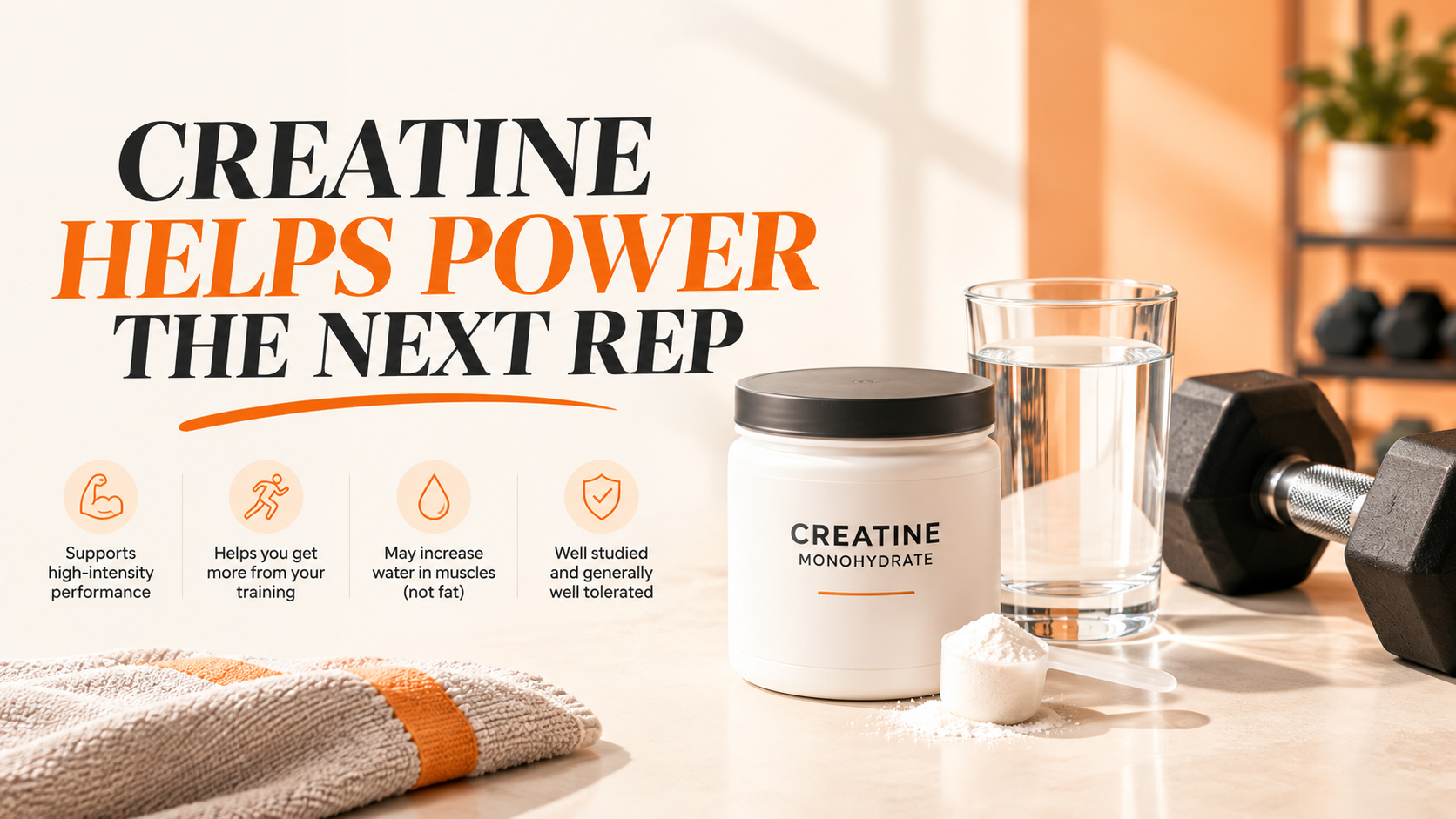
# Creatine Monohydrate: What Does It Actually Do for Your Muscles?
You have started strength training. Your squats feel more controlled, your dumbbells are getting heavier, and you are finally enjoying the routine.
Then someone at the gym says:
"You should start taking creatine."
Another person warns you:
"Be careful. Creatine makes you gain weight."
And suddenly, a simple supplement sounds confusing.
Does creatine really help your muscles? Is the weight gain fat? And do you need it if you are not a professional athlete?
Let's understand what creatine does, what the research supports, and when it may be worth considering.
What Is Creatine?
Creatine is a naturally occurring compound made by your body from amino acids. You also obtain some creatine from foods such as meat and fish.
Most of the creatine in your body is stored in skeletal muscle, where it exists as free creatine and phosphocreatine.
Your muscles use a molecule called adenosine triphosphate, or ATP, to power contraction.
ATP provides energy for muscular work, but the amount immediately available is limited.
Phosphocreatine helps regenerate ATP quickly during short periods of demanding activity.
Think of it as a rapid energy-support system for your muscles.
It is particularly useful when you need to produce substantial effort over a short period.
How Does Creatine Help During Exercise?
Imagine performing a challenging set of squats.
Your muscles need energy quickly as you lift the weight.
During the hardest repetitions, your phosphocreatine stores help regenerate ATP.
As the set continues, those stores become depleted, and your muscles increasingly rely on other energy systems.
Creatine supplementation can increase muscle creatine and phosphocreatine stores, helping support repeated bouts of high-intensity exercise.
This may improve your ability to perform demanding training over time.
Examples include:
- Resistance training with challenging weights
- Short sprints
- Repeated high-intensity intervals
- Explosive sporting movements
Creatine does not replace training. It may help you get more from the training you consistently perform.
Does Creatine Help Build Muscle?
Research suggests that creatine monohydrate, particularly when combined with resistance training, can improve strength and gains in lean body mass.
But an important distinction matters.
Creatine does not directly build muscle simply because you swallow a scoop.
Its benefits are partly related to improving your capacity to perform high-intensity work and accumulate productive training over time.
It can also increase the water stored within muscles.
That means some early increases in lean body mass are not necessarily new muscle protein.
Longer-term improvements may include genuine muscle growth when creatine is combined with appropriate resistance training.
Your training programme, nutrition, recovery and consistency remain essential.
Does Creatine Cause Weight Gain?
It can increase body weight, particularly during the first days or weeks of supplementation.
But weight gain does not automatically mean fat gain.
Creatine can increase the amount of water retained within muscle tissue.
For example, imagine your body weight is 68 kg before starting creatine.
After a few weeks, your weight is 68.8 kg.
That 800-gram increase does not prove that you gained 800 grams of body fat.
Some of the change may reflect increased muscle water, alongside normal fluctuations in body weight.
The amount varies between individuals, and not everyone experiences a noticeable increase.
This is why it is useful to look beyond a single reading on the scale.
Creatine Monohydrate vs Other Forms
Supplement companies sell several forms of creatine, including creatine hydrochloride, buffered creatine and creatine ethyl ester.
However, creatine monohydrate is the most extensively studied form.
It has substantial evidence supporting its effectiveness for improving high-intensity exercise performance.
Other forms are sometimes advertised as having better absorption, causing less water retention or producing faster results.
Those marketing claims do not establish that they are superior.
For most adults considering creatine supplementation, standard creatine monohydrate is the evidence-based starting point.
How Much Creatine Should You Take?
A commonly studied maintenance dose is 3–5 grams of creatine monohydrate per day for healthy adults.
Some research protocols use a loading phase of approximately 20 grams per day, divided into smaller servings, for around five to seven days, followed by a maintenance dose.
Loading can increase muscle creatine stores more quickly, but it is not essential.
Taking a regular maintenance dose can also increase stores over several weeks.
There is no need to chase a precise minute before or after exercise.
Consistent intake matters more than an elaborate timing routine.
Creatine can be mixed with water or another suitable drink.
If it causes digestive discomfort, taking a smaller amount with food may help.
Do You Need Creatine on Rest Days?
If you choose to supplement, creatine is generally taken daily, including rest days.
The aim is to maintain elevated muscle creatine stores rather than create a brief stimulant-like effect before a workout.
Creatine is not a pre-workout stimulant.
It does not need to produce a noticeable sensation for it to be working.
Is Creatine Safe?
Creatine monohydrate has been studied extensively.
In healthy adults, standard recommended doses are generally well tolerated, and research has not shown consistent evidence of kidney damage from appropriate use.
However, this does not mean creatine is appropriate for everyone.
People with kidney disease, abnormal kidney-function results, significant medical conditions, or medications that may affect kidney function should speak with a qualified healthcare professional before using it.
Pregnant or breastfeeding individuals should also seek individualized medical advice because safety evidence is limited.
Creatine supplementation can increase blood creatinine levels in some circumstances. Creatinine is a marker commonly used in kidney-function testing, so clinicians should know if you take creatine when interpreting your results.
Possible side effects include digestive discomfort and changes in body weight due to water retention.
Use a reputable, quality-tested product and avoid assuming that higher doses produce better results.
Does Creatine Help Everyone Equally?
No.
Responses vary.
People who begin with relatively low muscle creatine stores may experience a larger increase in those stores after supplementation.
People who already have higher stores may experience a smaller response.
Training experience, exercise type, diet and individual physiology can also influence results.
Someone performing regular resistance training may find creatine more useful than someone whose only activity is relaxed walking.
There is less consistent evidence that creatine improves ordinary steady-state endurance exercise.
Do Vegetarians Benefit From Creatine?
Creatine is found naturally in animal-derived foods, particularly meat and fish.
People following vegetarian diets may have lower dietary creatine intake.
Some studies suggest that vegetarians can have lower baseline muscle creatine stores and may experience substantial increases with supplementation.
However, that does not mean every vegetarian needs creatine.
Your training goals, dietary habits and personal circumstances should guide the decision.
For Indian adults following vegetarian diets, creatine monohydrate can be considered as an optional supplement rather than a nutritional necessity.
What Creatine Cannot Do
Creatine is not a shortcut to fitness.
It does not:
- Automatically burn body fat
- Replace adequate dietary protein
- Replace progressive strength training
- Guarantee muscle growth without appropriate exercise
- Work like caffeine to provide an immediate feeling of energy
It is one tool that may support certain kinds of training.
A Practical Example
Consider two people who begin a structured strength-training programme.
Person A trains three times per week, eats enough protein, gradually increases training difficulty and gets adequate recovery.
Person B follows a similar programme and also takes a consistent daily dose of creatine monohydrate.
Both can improve their strength and fitness.
Person B may experience an additional benefit in repeated high-intensity performance and, over time, strength or lean-mass gains.
But the size of that benefit is not guaranteed, and supplementation cannot compensate for an inconsistent training routine.
Creatine may support the process. The process still matters most.
Should You Take Creatine?
Before purchasing a supplement, ask yourself:
- Am I following a consistent training programme?
- Are my nutrition and recovery habits reasonably well established?
- Do my activities involve repeated high-intensity muscular effort?
- Do I understand the possible water-weight changes?
- Do I have any medical reason to seek professional advice first?
If you are just beginning to exercise, creatine does not have to be your first priority.
Learning movement technique, developing consistency, eating adequately and recovering well are more fundamental.
If you already train regularly and want to improve strength or repeated high-intensity performance, creatine monohydrate may be worth considering.
The Fit With Jennifer Takeaway
Fitness progress rarely comes from one dramatic change.
It comes from ordinary actions repeated with care: one more controlled repetition, one better night of sleep, one training session completed when motivation is low.
Creatine may help support some of those efforts.
But the real transformation still belongs to the work you do.
Build the foundation first. Let supplements support it, not replace it.
At Fit With Jennifer, we help you develop personalized strength-training and fitness routines that fit your goals and lifestyle.
Explore our coaching services at fitwithjennifer.com.
---
References
- Kreider RB, et al. International Society of Sports Nutrition position stand: Safety and efficacy of creatine supplementation in exercise, sport, and medicine. Journal of the International Society of Sports Nutrition. 2017.
https://doi.org/10.1186/s12970-017-0173-z
- Antonio J, et al. Common questions and misconceptions about creatine supplementation: What does the scientific evidence really show? Journal of the International Society of Sports Nutrition. 2021.
https://doi.org/10.1186/s12970-021-00412-w
- NIH Office of Dietary Supplements. Dietary Supplements for Exercise and Athletic Performance — Health Professional Fact Sheet.
https://ods.od.nih.gov/factsheets/ExerciseAndAthleticPerformance-HealthProfessional/
- Branch JD. Effect of creatine supplementation on body composition and performance: A meta-analysis. International Journal of Sport Nutrition and Exercise Metabolism. 2003.
https://doi.org/10.1123/ijsnem.13.2.198